Somewhere, somebody has finished a degree and posted a photograph of the
certificate on LinkedIn. The gown, the grin, the paper held up to the
camera. Every summer, LinkedIn fills with the same photograph.
That photograph is also a security document, taken in good light, and
published where anyone can find it.
A case we handled at Verifile began with a photograph like that one.
A candidate had applied for a job at a multinational bank, and the bank
asked us to verify his degree.
We'll call him Adam*.
The lesser award
Adam declared a Bachelor of Science in Finance from the University of
Reading, awarded about eighteen months earlier. Last October our client
asked us to verify the degree.
What Adam achieved through the University of Reading was not a
bachelor's degree. It was a Certificate of Higher Education in Business,
or in the university's own words, "a lesser award".
The Department for Education puts a Certificate of Higher Education at the
same level as the first year of a bachelor's degree. A bachelor's
degree with honours is two levels higher and takes three years. Adam had
about one year of study, and he had claimed three.
There was even more in the university's record. Adam had begun a
pharmacy degree at Reading a few years earlier and left it without
finishing, then started again with the finance course in mind.
He had been a student at Reading. He had claimed a bachelor's degree he
did not have.
The certificate
Most checks would stop there. We had the answer our client had asked for,
and the discrepancy was plain.
Nevertheless, we went further because a discrepancy that size can also be
somebody's mistake, and a mistake left uncorrected would cost Adam his
career. We asked Adam for a copy of his bachelor's degree certificate,
so the document itself could go in front of the university.
He sent the certificate the next day.
Almost nobody really looks closely at a degree certificate. You look at it,
the crest is in the right place, the name matches the CV, and you move on to
the next thing in the pile. This certificate would have passed that look. It
gave Adam a 2:1, and nothing about it invited a second glance.
We sent the certificate to the University of Reading and asked whether the
certificate was theirs. The answer came back within the week.
"I can verify that the information we have already given is
correct... The University cannot verify the attached document as
official.
The University considers that the document may be forged and is
therefore undertaking further investigations. The student number on the
certificate does not match this student's name.
We will then undertake further investigations and submit these to the
Head of Governance and the University Secretary for a review."
One line in there did the work.
The student number on the certificate does not match this student's
name.
The student in question was Adam.
This certificate carried Adam's name above somebody else's student
number. And Adam had a student number of his own, because he really had
studied at Reading.
The number that belonged to somebody else
Curiosity got the better of our team. One of them went looking through other
Reading certificates, to see where that student number might have come from.
Hundreds of images came back, which is what happens when you search for a
document that thousands of people are proud of. Among them was a LinkedIn
post from a real graduate, holding up their certificate, exactly the
photograph anybody would take.
The student number on that graduate's certificate was also the student
number on Adam's.
What our team felt was shock, and then a kind of amusement at the lengths
Adam had gone to.
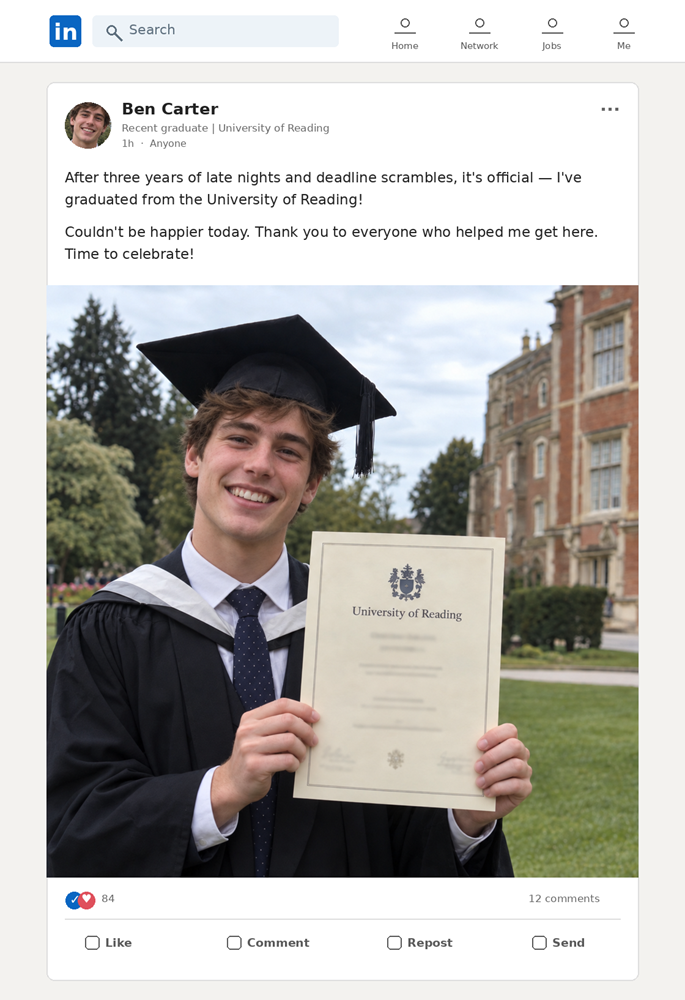 Illustration created with AI. Every summer LinkedIn fills with this photograph, and everything printed on the certificate is in it.
Now the typography made sense. The course name and the date both sit in the
wrong typeface, and those are two of the three things Adam had to change.
The third was the name. The student number did not have to be changed at
all, so Adam left the student number where it was, and the student number
was the one thing on the page that led back to a real person.
We do not know how many employers had taken this certificate at face value
before us. Or background screening providers.
What we could not finish
The University of Reading's last word referred the matter to its Head of
Governance and University Secretary, and the university never told us what
they decided. Nobody put the graduate's LinkedIn post to Adam, and we
never learned what our client did next.
What settled this case was not a close reading of the document. It was
asking the University of Reading, because the university was the only party
that could confirm the award. And it was going back a second time when the
first answer did not add up, because accuracy has to work in both
directions. The same second look that caught Adam is what would have cleared
him, had the university been the one who got it wrong.
The certificate that made all of this possible had been sitting in public
the whole time, in good light, at a resolution somebody else could work
from.
Names and certain details have been changed for confidentiality.
Verification Chronicles is our record of the cases that come through our
verification team, real files, names changed, told as they happened. We
publish them because the next employer to see one of these should
recognise it faster than we did.
Read more episodes →