The candidate answered in a day.
In screening, that usually means somebody organised, somebody who wants the
job and keeps their paperwork where they can find it. A quick reply is the
one you hope for.
Here, it was the first thing that gave him away.
A client had asked us to check his criminal record in Dubai, where he had
lived and worked for years.
We'll call him Martin*.
The check that has to go through the candidate
We can usually ask the organisation that holds the record. A university
confirms a degree. An employer confirms a job. The answer comes back from
the organisation holding the record, and the candidate never touches it on
the way.
Criminal records are different. In some countries the law lets us ask for a
candidate's record ourselves. In others, the law does not, and the
record can only be released to the person it belongs to. The UAE, and
specifically the Dubai Police Clearance Certificate, is one of those. For
Dubai, we ask the candidate to get their own Police Clearance Certificate,
which is what a criminal record check in Dubai produces, and to send it to
us. Then we check what arrives. A request a person has to make for their own
records has a name, and the name is a subject access request.
The certificate therefore reaches us from Martin, and not from the Dubai
Police.
Altering any document is fraud, whatever the document is. The ones we most
often see altered are employment dates and degree grades. This was a
criminal record certificate, and a criminal record check is arguably the
most important check anybody runs. Many of our clients ask for one in every
country a candidate has lived in during the period being verified, not only
the one they live in now. Martin had spent years in the UAE and Dubai, so it
was on the list.
We sent Martin the instructions. The certificate came back the next day, as
a PDF.
Two things that could not both be true
A Dubai Police certificate takes twenty-four hours to two days if you apply
from inside the UAE. From outside, it takes three to five days. Martin was
applying from outside the UAE.
Then we looked at the date on the certificate itself.
It had been issued five days before we sent him the instructions.
Martin had not been quick. The certificate had existed before we asked for
it.
The service that checks itself
We could not ask the Dubai Police for Martin's record. We could ask
them about the certificate he had sent us, because the Dubai Police run an
online verification service. Enter the reference number and the security
code printed on a certificate, and the service confirms whether the
certificate matches a real record.
We entered Martin's reference number and security code.
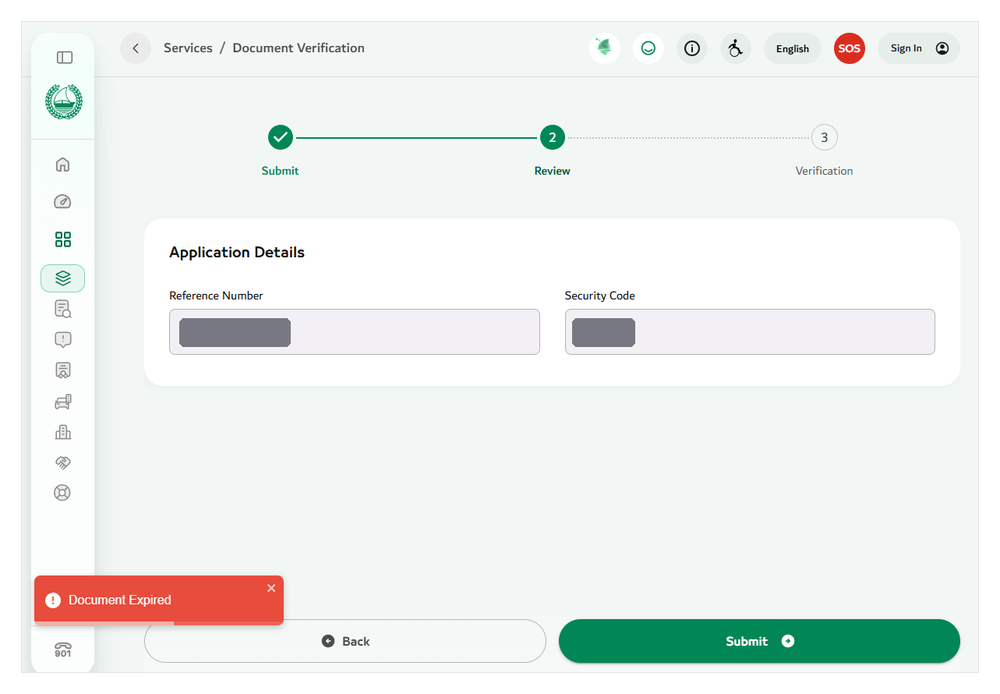 The Dubai Police verification service, with the reference number and the security code removed.
The service returned two words. Document Expired.
The message shows for a few seconds and then disappears. Our verifier had to
read it and screenshot it before it vanished.
Printed on the certificate itself, inside a red box near the foot of the
page, is the line that makes the result impossible.
"This certificate is valid for three month."
A certificate really issued five days earlier could not have expired.
The Dubai Police database holds the date the certificate was really issued.
Martin's certificate showed a different date, printed on the document
itself. The database was right, and the certificate had run out long before
Martin sent it to us.
We told the client what the database had returned. We also sent them our own
comparison of Martin's certificate against a genuine one, so they could
see the difference for themselves.
The parts nobody thinks about
We had the answer our client had asked for. We went further, and put
Martin's certificate side by side with a Dubai police certificate
belonging to another case, one we had already checked against the database
and knew to be genuine.
A Dubai police certificate carries two crests along the top of the page. One
belongs to the Government of Dubai and one belongs to the Dubai Police.
On the genuine certificate, the Government of Dubai crest is the one the
emirate adopted in 2024. On Martin's certificate, it is the crest the
emirate used before then.
The Dubai Police crest, printed beside it, is the same on both documents. Of
the two crests on Martin's page, one is right and one is years out of
date.
 The Government of Dubai emblem on a genuine certificate, and on the one we were sent.
To the right of the two crests, both certificates name the department that
issued them, the General Department of Criminal Investigation. On the
genuine certificate those words sit in one typeface. On Martin's they
sit in another, at a different size, and they do not line up the same way.
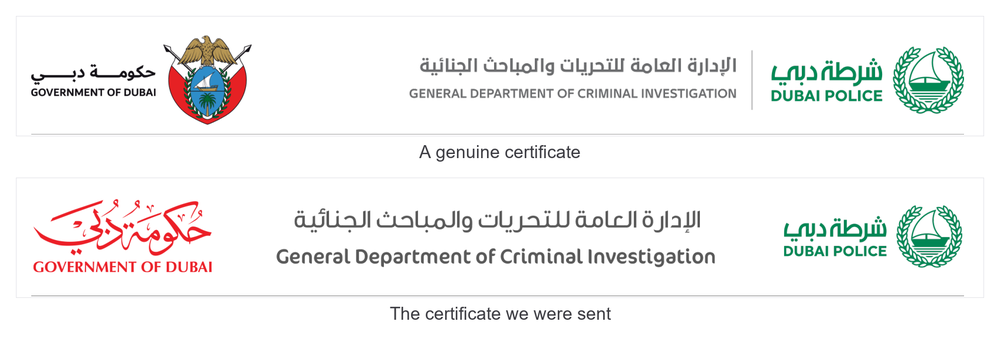 The top of both certificates. The department's name is set differently on the one we were sent.
And along the bottom of Martin's certificate, on a document supposed to
be weeks old, is the logo for Expo 2020. What the team felt when they found
it was amusement, at an oversight nobody had thought to look for.
 The foot of the certificate we were sent, with the Expo 2020 logo ringed.
What Martin probably did
Nobody had asked us to look at Martin's CV. It had been uploaded with
the rest of his file, so we read it, and it showed exactly when he had been
working in Dubai.
Anybody employed there at that time would have needed a Police Clearance
Certificate, and would have gone through the proper process to get one. Our
team's reading is that Martin already had one, and that he changed the
date on it instead of applying for a new one.
Why he did that, when a new certificate would have taken a week, is the one
thing in the file nobody can answer.
What to do when a document comes from the candidate
Where the law puts the candidate in the middle, they stay in the middle.
What an employer can change is what happens after the document lands.
Ask the body that issued it whether they will confirm it. Many now run an
online service where you type in the certificate's own reference number
and get an answer back in seconds, and that answer is worth more than an
hour spent looking at the page.
Get hold of a genuine certificate of the same kind and put the two side by
side. If you have not got one, search for images of the document online.
Plenty of people publish redacted copies, and even a rough idea of what the
real thing looks like will tell you whether the crest, the colours and the
fonts are right.
Then look at the document as an object rather than as information. Are the
lines clean? Is everything aligned? Does any part of it look unprofessional,
or simply odd?
Check the date it was issued against your own records. A certificate dated
before you asked the candidate for it needs explaining, and so does one that
came back faster than the issuing body could have produced it.
And read the top and the bottom of the page. On Martin's certificate,
those two strips carried the old emblem and the Expo 2020 logo, and both had
survived every other change he made.
What settled it
A document that reaches you through the person it describes tells you what
that person wanted you to know. It becomes a verification at the moment
somebody asks the source. In this case, the source was a database, and
Martin's own certificate carried the number that let us ask it.
Names and certain details have been changed for confidentiality.
Verification Chronicles is our record of the cases that come through our
verification team, real files, names changed, told as they happened. We
publish them because the next employer to see one of these should
recognise it faster than we did.
Read more episodes →